

A view from the Philadelphia balcony where the protective guardrail failed to stop the fall of siding installer
Siarhei Marhunou.
Photo: Pennsylvania State Court Files
The last earthly contact Siarhei Marhunou had with a construction material was with a 2 x 4 that was part of a protective guardrail on the balcony where he had been installing siding. The barrier had been erected by a prior contractor that worked at 2330 Sansom Street, a Philadelphia residence undergoing renovation, some time before Marhunou’s arrival at the job in December 2021. The guardrail apparently was too low to meet the federal standard for edge barriers where a ladder was in use and lacked a midrail, an expert witness for Marhunou’s widow reported in her negligence lawsuit against the companies on the project.
No one saw the fall begin or knows if Marhunou, who had no harness or tie-off, thought the guardrail could provide help in case he lost his balance. According to the report, Marhunou apparently smashed through the 2 x 4s as he went over the balcony edge and fell 50 ft, sustaining severe head and chest injuries that killed him. A video of the last 10 ft of his fall showed part of the barrier dropping with him.
Fatal falls continue to account for the greatest number of construction deaths, stubbornly staying in the 250-300 range each year from 2018-22, according to U.S. Labor Dept. data. The department says it investigated fewer construction deaths from falls in the last two years, 234 and 189, respectively.
A small but persistent subset of those accidents involve barriers that fail to meet federal standards: thin
plywood boards dropped over slab openings, ramp edges “protected” by tape or rope and improvised,
sometimes rickety wooden guardrails nailed together with whatever extra materials were on hand.
These improvised, noncompliant barriers are in some ways worse than a completely unprotected edge or
opening. While they may focus attention on a hazard, they also tend to induce confidence where none
should be placed, especially on construction of roof decks and slabs where safety harnesses and tie-offs
aren’t being used.
A mountain of research has been conducted on risk-taking behavior and human psychology as it bears
on workplace safety. A few years ago, a civil engineering research team suspected that, similar to
motorists who drive faster in automobiles equipped with safety features, there could be an analog in
construction. After conducting studies of roofers’ behavior using virtual reality, the researchers
published their findings in a 2020 article in the ASCE Journal of Construction Engineering and
Management. The results indicated that workers tend to take more risks when they feel protected by
strict safety measures such as perimeter barriers and roof tie-offs (ENR.com 4/13/2021).
Those researchers, of course, didn’t conduct studies on substandard protective measures. But over 20
years ago, consultant J. Nigel Ellis called out the hazards presented by openings covered with loose
plywood or plastic sheet and shingles that look like a walking surface on a partially decked roof. “The
rule is that if it looks like it can be walked on, it will be walked on,” Ellis wrote in a commentary
(ENR.com 8/2/2005). “No matter how careful you are, falls are inevitable with some exposures or
hazards.” He called such hazards human fall traps, and said “they typically produce serious injury and
death.”
More recently, another safety consultant who has also embraced hazard removal rather than relying only
on training workers to recognize hazards and stick to safety rules, has spoken about the dangers of
improvised, out-of-compliance guardrails and opening covers. “There’s more risk-taking where there is a
barrier,” says T.J. Lyons, a former contractor safety manager who now runs Lyonetics Consulting, based
in Saratoga Springs, N.Y. He says that human curiosity often triumphs over good sense, giving the
example of an excavation crew going to the edge of an excavation to look inside or a roofing crew
heading to the perimeter to look down at what’s happening at street level. “There’s a tendency to see
what’s going on,” he says, adding that, “We should be more afraid of openings.”
Lyons, who is co-chair of the American National Standards Institute Prevention through Design
standard committee, says that a safe workplace is one that takes account of tendencies in human
behavior. “People will take the path of least resistance as they go about their work during the day,” Lyons
says. “So if you eliminate the opportunity for the worker to decide what is safe or not safe, that’s half the
battle.” A proper physical barrier, he says, is needed to corral workers and keep them safely away from
edges and walking where it is safe.
Just like the Philadelphia accident that killed Marhunou, where small companies were at work, big
companies are susceptible to lapses where guardrails are put in place that fail to meet OSHA’s 200-lb
minimum force standard.
One tragedy from recent years began about 6 a.m. in Aug. 9, 2019, when electrician Henry Hortillosa, 67,
was working inside the mechanical room on the fifth floor of a six-story commercial building in Las
Vegas. A 90 x 54-in. slab opening had what a Nevada Dept. of Labor inspector described as a “guardrail
system” installed around the opening, but someone had “disconnected/removed” the midrail on the
right side of the railing. Only the nails on the left held it together, the inspector wrote in a report.
Hortillosa was installing wire for a fire alarm as part of the staff of Helix Electric, a major open-shop
electrical contractor. No one is sure exactly what occurred, including whether Hortillosa could discern
what was wrong with the guardrail, but he fell through the opening to the second floor and struck the
concrete surface 28 ft below, suffering fatal skull fractures and brain hemorrhaging.
A GoFundMe campaign organized by Helix on behalf of Hortillosa’s widow, Chona, provided her
$12,220. Nevada safety officials found Helix not to be at fault but did propose a penalty against another
company at work on the project.

From left to right, an atrium frame with openings through which a worker could easily fall; a thin, slippery plywood cover;
and the unprotected side of a floor deck opening.
Photos: Courtesy of Lyonetics Consulting
Another Tragic Accident
Two years later another tragic accident involving a big company took place at a 19-story downtown
Manhattan high-rise. Michael R. Melfi, a 33-year-old union ironworker, was part of a bolt-up gang for
South Plainfield, N.J.-based Stonebridge Steel Erection. A pre-shift safety briefing had been held.
There’s general agreement on what happened next because a video camera recorded the accident.
According to accounts of the accident given in testimony to the New York City Dept. of Buildings, Melfi
that day was scheduled to bolt up a brace and beams on the sixth floor, where there was an elevator shaft
opening protected by a cable guardrail system.
Protective guardrails where wire ropes serve as the top and intermediate horizontal elements meet
OSHA fall-protection regulations—as long as the cables are tautly secured to the vertical supports, free of
sharp edges and deflect a maximum of 3 in. when a load of 200 lb is applied in any direction and the deflection includes the free-hanging sag in the wire rope.
At the New York project, the pre-shift safety meeting had established that a foreman must be contacted
before a worker, if there was a need, could cross into the area inside the cables protecting the elevator
shaft opening. The supervisor would then devise a plan involving a 100% tie-off to any of the tie-off
points at the elevator shaft.
In the case of Melfi, who had been provided a harness, the meeting did not happen. The elevator shaft
was not completely open: it was spanned by planks covered with steel mesh strong enough to catch
debris before they fell to the level below.
OSHA put the time of what happened next as 1 p.m.
Melfi’s work partner was lying on his back bolting the bottom flange of a beam, the project’s general
contractor’s safety supervisor told the Dept. of Buildings. Melfi, he said, “climbed in between the cables
and walked onto the debris catch, which gave way under his weight.” Melfi, not tied off, fell all the way to
the cellar level, a distance of 85 ft.
The same issues of training, perception and hazard removal are especially important when it comes to roof skylights. A
perpetual hazard, falls through skylights, killed 14 workers in 2023, OSHA records show.
The last one that year was Mario Alexis Lopez Raymundo. In November, he was employed by Macon, Ga.-based
contractor Nor-D at a local project where the crew was removing old roofing tar and stone from a flat metal roof
and dumping the material into wheelbarrows at the building sides.
Dome-type skylights, measuring 4 x 7 ft, were located throughout the 200 x 175-ft roof, according to OSHA’s inspection report. Raymundo, according to OSHA, “stepped onto a skylight dome and fell through” to the concrete warehouse floor below, striking his head. An ambulance rushed Raymundo to a nearby hospital where he succumbed to his injuries and died hours later.
In June, OSHA proposed $61,000 in penalties against Nor-D for 11 serious violations. OSHA claimed
that the contractor failed to protect employees by not using fall protection systems even though they
were working on a 19-ft-high roof, and leaving skylights without safety guardrails on the day of the fatal
incident. Company officials could not be reached for comment.
The skylight hazard to roof contractors and roof maintenance staff has been known for years. Writing in
ENR in 2005, safety consultant Ellis noted that typical plastic skylights age by crazing at screw holes and
through oxidation, creating a risk of sudden failure when stepped or sat on. He also pointed out the issue
of perception, because as “skylight and decking both oxidize to a similar color,” it becomes hard to
distinguish the skylight.
As things stand now, OSHA requires skylights in building roofs through which persons may fall while
walking or working to be guarded by a standard skylight screen or a fixed standard railing on all exposed
sides. Unless the plastic skylight can support a 200 lb load, a screen that can support it must protect the
skylight.
Lyons has said skylight accidents are easily preventable if owners and architects require the skylights to
withstand a worker’s weight. “Why not require installing skylights you can’t fall through?” he asks.
Some manufacturers have tried to answer that need by creating impact-resistant skylights. One of them
is Fort Worth, Texas-based Maxim Skylights. An industry-wide product performance standard is far
overdue, the company claims on its website, so instead of “waiting for our own industry to agree on a test
protocol or even a product performance standard,” the company tested two unit skylight models and one
roof system model that are impact-resistant.
Another manufacturer, Vaughan, Ontario-based Artistic Skylight Domes, markets what it describes as its
Fall Protection Series lenses made from ultra-high impact-resistant polycarbonate material. Artistic
Skylight Domes tested the products at an independent laboratory where the results showed that the
skylights “met and exceeded” what was required and even “successfully load tested to withstand a
maximum load drop of 250 lb up to 7 ft equaling 1,750 ft/lb of energy.”
Edge Protection Haves and Have Nots
The world of edge protection can partly be told as a story of haves and have nots. Small contractors on
smaller projects don’t have the time, money and motivation to enact the kind of comprehensive fall
protection measures that bigger employers on bigger projects can afford. For example, 15 years ago a
contractor may have been able to build 100 linear ft of compliant protective guardrail at the edge of a
concrete floor slab for $1,000 or so. It may have required a day of work by a crew using 4 x 4s as posts at
6 ft intervals, held to the slab via boots and Tapcon screws and linked by 2 x 4 toprails and midrails. The
cost today would be higher for both the labor and the materials. A healthy competition exists among
companies selling engineered edge protection systems.
The need for better fall protection inspired entrepreneurs to develop and sell engineered, reusable
protective guardrails that can be moved up from floor to floor as a building rises, and then stored and
transported to other projects. A major difference in the systems and the options each company offers is
in the engineering design of the vertical supports: whether they are anchored into hardware inserted into
a floor slab, whether drilling to insert screws is needed or whether the post sits on top of the slab or roof
deck using a specially designed foot. The support’s design makes a difference in how the needed OSHA
200-lb loading requirement is met and how the protective guardrail is assembled in the field.
Former contractor safety professional Deb Hilmerson founded Hilmerson Safety 25 years ago to meet a
need she saw for re-usable protective guardrails that are OSHA and code compliant and which made
sense. The Hilmerson Safety Rail System uses galvanized steel that won’t rust in the way that light-gauge
painted rail may, the company states. The rails will last 15 years, and “will pay for themselves,” says a
company video.
Hilmerson says she prefers to provide online installation instruction to contractors because the work is
“simple to do yourself.” The weighted feet beneath the vertical supports, which rest on a concrete floor
slab, are also valuable on roofs because they eliminate drilling that could be problematic or ruin a roof
warranty.
In one video, Hilmerson demonstrates a two-person crew setting up 120 linear ft of the weighted-foot
rail system at street level in 12 minutes.

A video of footing tests conducted for Safety Rail Source includes a machine with a label displaying the OSHA-compliant capacity of 200 lbs. Video screenshot: Courtesy of Safety Rail Source
Former mechanical contractor Hal Swindell started another fall protection product maker, Norristown,
Pa.-based Safety Rail Source, in 1999. He had designed and patented a roof hatch railing and continued
on from there. His company now designs and develops OSHA-compliant edge protection safety
products, including skylight screens and custom fall-arrest systems. Swindell counts among his
customers large contractors with hundreds of millions in revenue that invest heavily in fall protection.
Safety Rail Source sells mostly non-penetrating systems, Swindell says, that use a specially designed
footing for the posts. It can provide a turnkey service that includes installation where Safety Rail Source
brings in another firm as installation subcontractor. A penetrating system purchased by a customer
would have to be installed by a certified contractor, he adds.
Early Planning Role Preferred
Swedish company SafetyRespect is another competitor in the fall protection space. Steven Espinosa is
president of SafetyRespect USA, the company’s Palm Desert, Calif.-based U.S. office.
SafetyRespect’s perimeter edge protection product is different in that rather than using rails, there is a
lattice mesh panel supported by posts. The panel essentially combines the functions of a top rail,
kneeboard and toeboard. “We can protect the entire perimeter and all interior voids,” says Espinosa,
who adds that the company’s products and services are used in high-rises, data centers, arenas and
stadiums.
General contractors or subcontractors install the company’s edge fall-protection system. If called in
before a slab is cast, SafetyRespect can help plan the installation and layout of the posts. “A couple of
months early,” is how Espinosa describes the ideal amount of time needed for that planning. If a slab is
already cast, SafetyRespect’s system can also be easily installed using a different system that also
involves a slab penetration.
While engineered fall protection systems are effective, OSHA-compliant edge protection is attainable for
small contractors and small projects—if there is a commitment. There’s no place for a noncompliant
barrier that will invite disastrous misplaced trust.
“You can build proper guarding on a project with common materials,” says Lyons, the safety consultant.
“The misstep is trying to build the protection only with materials you have available on a jobsite versus the materials that were planned for it.”
With additional reporting by Jonathan Barnes
This story was updated Feb. 27 to reflect the fact that the Nevada Dept. of Labor found Helix Electric
not to be at fault and instead cited another company for a violation related to the accident where
Henry Hortillosa died.
Article Courtesy of Richard Korman, dated February 26, 2025 ~ Engineering News-Record
A small but persistent subset of those accidents involve barriers that fail to meet federal standards: thin plywood boards dropped over slab openings, ramp edges “protected” by tape or rope and improvised, sometimes rickety wooden guardrails nailed together with whatever extra materials were on hand.
These improvised, noncompliant barriers are in some ways worse than a completely unprotected edge or opening. While they may focus attention on a hazard, they also tend to induce confidence where none should be placed, especially on construction of roof decks and slabs where safety harnesses and tie-offs aren’t being used.
A mountain of research has been conducted on risk-taking behavior and human psychology as it bears on workplace safety. A few years ago, a civil engineering research team suspected that, similar to motorists who drive faster in automobiles equipped with safety features, there could be an analog in construction. After conducting studies of roofers’ behavior using virtual reality, the researchers published their findings in a 2020 article in the ASCE Journal of Construction Engineering and Management. The results indicated that workers tend to take more risks when they feel protected by strict safety measures such as perimeter barriers and roof tie-offs (ENR.com 4/13/2021).
Those researchers, of course, didn’t conduct studies on substandard protective measures. But over 20 years ago, consultant J. Nigel Ellis called out the hazards presented by openings covered with loose plywood or plastic sheet and shingles that look like a walking surface on a partially decked roof. “The rule is that if it looks like it can be walked on, it will be walked on,” Ellis wrote in a commentary (ENR.com 8/2/2005). “No matter how careful you are, falls are inevitable with some exposures or hazards.” He called such hazards human fall traps, and said “they typically produce serious injury and death.”
More recently, another safety consultant who has also embraced hazard removal rather than relying only on training workers to recognize hazards and stick to safety rules, has spoken about the dangers of improvised, out-of-compliance guardrails and opening covers. “There’s more risk-taking where there is a barrier,” says T.J. Lyons, a former contractor safety manager who now runs Lyonetics Consulting, based in Saratoga Springs, N.Y. He says that human curiosity often triumphs over good sense, giving the example of an excavation crew going to the edge of an excavation to look inside or a roofing crew heading to the perimeter to look down at what’s happening at street level. “There’s a tendency to see what’s going on,” he says, adding that, “We should be more afraid of openings.”
Lyons, who is co-chair of the American National Standards Institute Prevention through Design standard committee, says that a safe workplace is one that takes account of tendencies in human behavior. “People will take the path of least resistance as they go about their work during the day,” Lyons says. “So if you eliminate the opportunity for the worker to decide what is safe or not safe, that’s half the battle.” A proper physical barrier, he says, is needed to corral workers and keep them safely away from edges and walking where it is safe.
Just like the Philadelphia accident that killed Marhunou, where small companies were at work, big companies are susceptible to lapses where guardrails are put in place that fail to meet OSHA’s 200-lb minimum force standard.
One tragedy from recent years began about 6 a.m. in Aug. 9, 2019, when electrician Henry Hortillosa, 67, was working inside the mechanical room on the fifth floor of a six-story commercial building in Las Vegas. A 90 x 54-in. slab opening had what a Nevada Dept. of Labor inspector described as a “guardrail system” installed around the opening, but someone had “disconnected/removed” the midrail on the right side of the railing. Only the nails on the left held it together, the inspector wrote in a report.
Hortillosa was installing wire for a fire alarm as part of the staff of Helix Electric, a major open-shop electrical contractor. No one is sure exactly what occurred, including whether Hortillosa could discern what was wrong with the guardrail, but he fell through the opening to the second floor and struck the concrete surface 28 ft below, suffering fatal skull fractures and brain hemorrhaging.
A GoFundMe campaign organized by Helix on behalf of Hortillosa’s widow, Chona, provided her $12,220. Nevada safety officials found Helix not to be at fault but did propose a penalty against another company at work on the project.
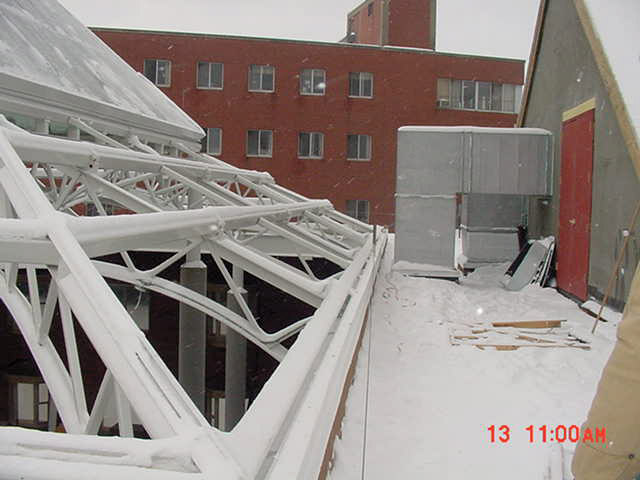
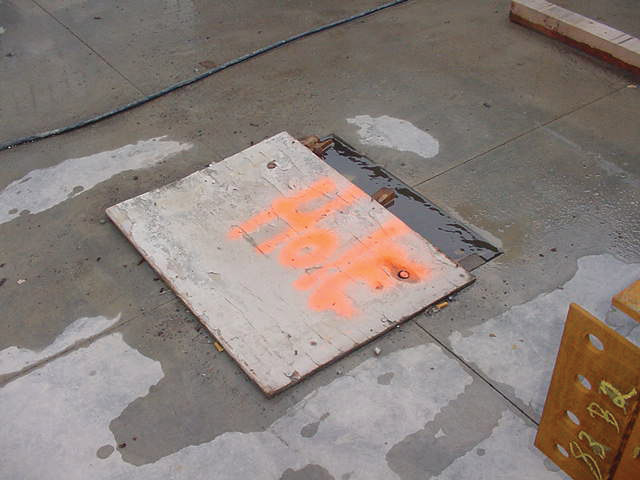
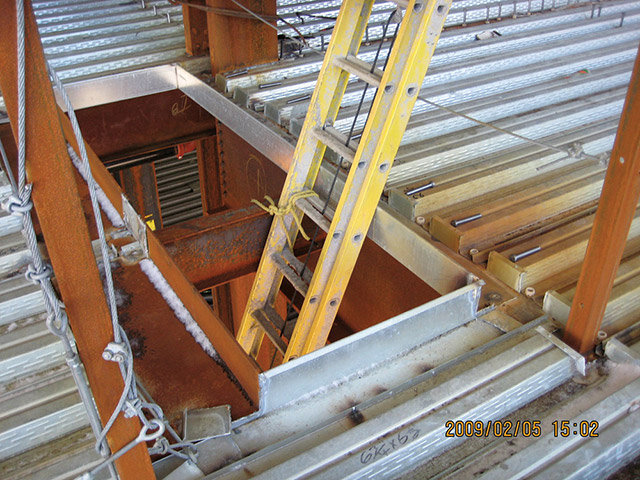
From top to bottom, an atrium frame with openings through which a worker could easily fall; a thin, slippery plywood cover; and the unprotected side of a floor deck opening.
Photos: Courtesy of Lyonetics Consulting
Another Tragic Accident
Two years later another tragic accident involving a big company took place at a 19-story downtown Manhattan high-rise. Michael R. Melfi, a 33-year-old union ironworker, was part of a bolt-up gang for South Plainfield, N.J.-based Stonebridge Steel Erection. A pre-shift safety briefing had been held.
There’s general agreement on what happened next because a video camera recorded the accident.
According to accounts of the accident given in testimony to the New York City Dept. of Buildings, Melfi that day was scheduled to bolt up a brace and beams on the sixth floor, where there was an elevator shaft opening protected by a cable guardrail system.
Protective guardrails where wire ropes serve as the top and intermediate horizontal elements meet OSHA fall-protection regulations—as long as the cables are tautly secured to the vertical supports, free of sharp edges and deflect a maximum of 3 in. when a load of 200 lb is applied in any direction and the deflection includes the free-hanging sag in the wire rope.
At the New York project, the pre-shift safety meeting had established that a foreman must be contacted before a worker, if there was a need, could cross into the area inside the cables protecting the elevator shaft opening. The supervisor would then devise a plan involving a 100% tie-off to any of the tie-off points at the elevator shaft.
In the case of Melfi, who had been provided a harness, the meeting did not happen. The elevator shaft was not completely open: it was spanned by planks covered with steel mesh strong enough to catch debris before they fell to the level below.
OSHA put the time of what happened next as 1 p.m.
Melfi’s work partner was lying on his back bolting the bottom flange of a beam, the project’s general contractor’s safety supervisor told the Dept. of Buildings. Melfi, he said, “climbed in between the cables and walked onto the debris catch, which gave way under his weight.” Melfi, not tied off, fell all the way to the cellar level, a distance of 85 ft.
“You can build proper guarding on a project with common materials. The misstep is trying to build the protection only with materials you have available on the jobsite versus the materials that were planned for it.” -T.J. Lyons, principal, Lyonetics Consulting
The same issues of training, perception and hazard removal are especially important when it comes to roof skylights. A perpetual hazard, falls through skylights, killed 14 workers in 2023, OSHA records show.
The last one that year was Mario Alexis Lopez Raymundo. In November, he was employed by Macon, Ga.-based contractor Nor-D at a local project where the crew was removing old roofing tar and stone from a flat metal roof and dumping the material into wheelbarrows at the building sides.
Dome-type skylights, measuring 4 x 7 ft, were located throughout the 200 x 175-ft roof, according to OSHA’s inspection report. Raymundo, according to OSHA, “stepped onto a skylight dome and fell through” to the concrete warehouse floor below, striking his head. An ambulance rushed Raymundo to a nearby hospital where he succumbed to his injuries and died hours later.
In June, OSHA proposed $61,000 in penalties against Nor-D for 11 serious violations. OSHA claimed that the contractor failed to protect employees by not using fall protection systems even though they were working on a 19-ft-high roof, and leaving skylights without safety guardrails on the day of the fatal incident. Company officials could not be reached for comment.
The skylight hazard to roof contractors and roof maintenance staff has been known for years. Writing in ENR in 2005, safety consultant Ellis noted that typical plastic skylights age by crazing at screw holes and through oxidation, creating a risk of sudden failure when stepped or sat on. He also pointed out the issue of perception, because as “skylight and decking both oxidize to a similar color,” it becomes hard to distinguish the skylight.
As things stand now, OSHA requires skylights in building roofs through which persons may fall while walking or working to be guarded by a standard skylight screen or a fixed standard railing on all exposed sides. Unless the plastic skylight can support a 200 lb load, a screen that can support it must protect the skylight.
Lyons has said skylight accidents are easily preventable if owners and architects require the skylights to withstand a worker’s weight. “Why not require installing skylights you can’t fall through?” he asks.
Some manufacturers have tried to answer that need by creating impact-resistant skylights. One of them is Fort Worth, Texas-based Maxim Skylights. An industry-wide product performance standard is far overdue, the company claims on its website, so instead of “waiting for our own industry to agree on a test protocol or even a product performance standard,” the company tested two unit skylight models and one roof system model that are impact-resistant.
Another manufacturer, Vaughan, Ontario-based Artistic Skylight Domes, markets what it describes as its Fall Protection Series lenses made from ultra-high impact-resistant polycarbonate material. Artistic Skylight Domes tested the products at an independent laboratory where the results showed that the skylights “met and exceeded” what was required and even “successfully load tested to withstand a maximum load drop of 250 lb up to 7 ft equaling 1,750 ft/lb of energy.”
Edge Protection Haves and Have Nots
The world of edge protection can partly be told as a story of haves and have nots. Small contractors on smaller projects don’t have the time, money and motivation to enact the kind of comprehensive fall protection measures that bigger employers on bigger projects can afford. For example, 15 years ago a contractor may have been able to build 100 linear ft of compliant protective guardrail at the edge of a concrete floor slab for $1,000 or so. It may have required a day of work by a crew using 4 x 4s as posts at 6 ft intervals, held to the slab via boots and Tapcon screws and linked by 2 x 4 toprails and midrails. The cost today would be higher for both the labor and the materials. A healthy competition exists among companies selling engineered edge protection systems.
The need for better fall protection inspired entrepreneurs to develop and sell engineered, reusable protective guardrails that can be moved up from floor to floor as a building rises, and then stored and transported to other projects. A major difference in the systems and the options each company offers is in the engineering design of the vertical supports: whether they are anchored into hardware inserted into a floor slab, whether drilling to insert screws is needed or whether the post sits on top of the slab or roof deck using a specially designed foot. The support’s design makes a difference in how the needed OSHA 200-lb loading requirement is met and how the protective guardrail is assembled in the field.
Former contractor safety professional Deb Hilmerson founded Hilmerson Safety 25 years ago to meet a need she saw for re-usable protective guardrails that are OSHA and code compliant and which made sense. The Hilmerson Safety Rail System uses galvanized steel that won’t rust in the way that light-gauge painted rail may, the company states. The rails will last 15 years, and “will pay for themselves,” says a company video.
Hilmerson says she prefers to provide online installation instruction to contractors because the work is “simple to do yourself.” The weighted feet beneath the vertical supports, which rest on a concrete floor slab, are also valuable on roofs because they eliminate drilling that could be problematic or ruin a roof warranty.
In one video, Hilmerson demonstrates a two-person crew setting up 120 linear ft of the weighted-foot rail system at street level in 12 minutes.

A video of footing tests conducted for Safety Rail Source includes a machine with a label displaying the OSHA-compliant capacity of 200 lbs. Video screenshot: Courtesy of Safety Rail Source
Former mechanical contractor Hal Swindell started another fall protection product maker, Norristown, Pa.-based Safety Rail Source, in 1999. He had designed and patented a roof hatch railing and continued on from there. His company now designs and develops OSHA-compliant edge protection safety products, including skylight screens and custom fall-arrest systems. Swindell counts among his customers large contractors with hundreds of millions in revenue that invest heavily in fall protection.
Safety Rail Source sells mostly non-penetrating systems, Swindell says, that use a specially designed footing for the posts. It can provide a turnkey service that includes installation where Safety Rail Source brings in another firm as installation subcontractor. A penetrating system purchased by a customer would have to be installed by a certified contractor, he adds.
Early Planning Role Preferred
Swedish company SafetyRespect is another competitor in the fall protection space. Steven Espinosa is president of SafetyRespect USA, the company’s Palm Desert, Calif.-based U.S. office.
SafetyRespect’s perimeter edge protection product is different in that rather than using rails, there is a lattice mesh panel supported by posts. The panel essentially combines the functions of a top rail, kneeboard and toeboard. “We can protect the entire perimeter and all interior voids,” says Espinosa, who adds that the company’s products and services are used in high-rises, data centers, arenas and stadiums.
General contractors or subcontractors install the company’s edge fall-protection system. If called in before a slab is cast, SafetyRespect can help plan the installation and layout of the posts. “A couple of months early,” is how Espinosa describes the ideal amount of time needed for that planning. If a slab is already cast, SafetyRespect’s system can also be easily installed using a different system that also involves a slab penetration.
While engineered fall protection systems are effective, OSHA-compliant edge protection is attainable for small contractors and small projects—if there is a commitment. There’s no place for a noncompliant barrier that will invite disastrous misplaced trust.
“You can build proper guarding on a project with common materials,” says Lyons, the safety consultant. “The misstep is trying to build the protection only with materials you have available on a jobsite versus the materials that were planned for it.”
This article was originally created by Richard Korman at Engineering News-Record, February 26, 2025.
With additional reporting by Jonathan Barnes
This story was updated Feb. 27 to reflect the fact that the Nevada Dept. of Labor found Helix Electric not to be at fault and instead cited another company for a violation related to the accident where Henry Hortillosa died.

